
OUR CERTIFICATE PROGRAM IN
Peacemaking & Justice
Peacemaking and Justice in the Palestinian Context I & II are guided, asynchronous online courses introducing the theory and practice of peacemaking and justice in Palestine and Israel, drawing on insights from Palestinian Christians and international scholars.
Together with the Summer Intensive in Bethlehem, they form the Certificate Program in Peacemaking and Justice in the Palestinian Context.
The Summer Intensive in Bethlehem serves as the capstone to this certificate.
Our Certificate Program
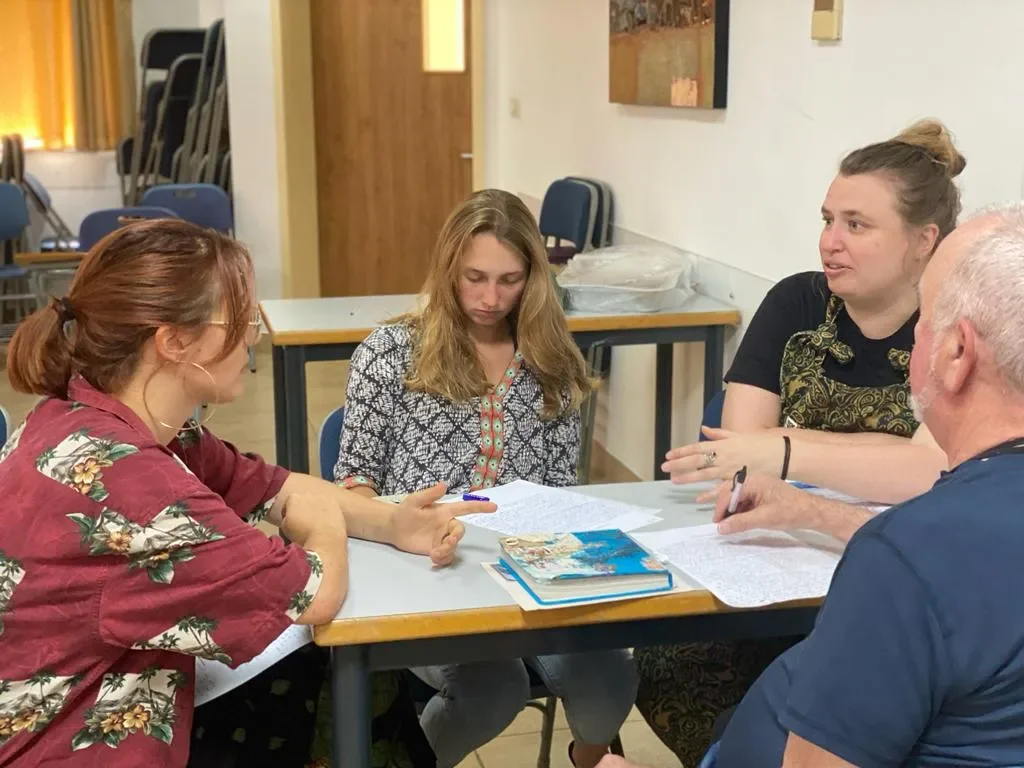
Student discussion on location at the Bethlehem Bible College
The certificate program consists of 3 courses:
PEACEMAKING & JUSTICE IN THE PALESTINIAN CONTEXT 1
Explores fundamental concepts in peacemaking and justice, the history of the Israeli/Palestinian conflict and present realities on the ground; Biblical theologies of peace; reflections on peace and justice from the perspective of Judaism and Islam; non-violence and peacemaking; the practice of sulha in Arab societies and how it relates to other models of reconciliation; conflict and identity in the Palestinian context; the importance of indigenous narrative; the pursuit of social justice for minority peoples in Myanmar; and the possibilities for peace and justice for all the people of Palestine and Israel.
$495 | 3 credit hrs
Fall
PEACEMAKING & JUSTICE IN THE PALESTINIAN CONTEXT 2
Builds on Peacemaking and Justice in the Palestinian Context 1 but also may be taken as a stand-alone course. This course will continue the introduction to essential tools for peacemakers in contexts of conflict throughout the world. It will explore the importance of culture in peacemaking, steps in reconciliation, the pursuit of justice for Dalits (untouchables) in India, and racial justice in South Africa; the importance of Christian and Muslim dialogue in the Middle East; Western Christian and Palestinian Christian perspectives on the Palestinian/Israeli conflict and prospects for peace; international law, human rights, and peace and justice; women in peacemaking in Israel and Palestine; spirituality and the peacemaker; and current grassroots peace initiatives in Israel and Palestine.
$495 | 3 credit hrs
Spring
$2,420 | 6 credit hrs
Summer
Includes room & board: 2 meals per day
BETHLEHEM SUMMER INTENSIVE
An immersive learning experience that brings students into direct encounter with the land, people, and realities that shape the Palestine-Israel conflict. Rooted in the witness of the Palestinian Church, the program weaves together biblical reflection, theological formation, classroom learning, and firsthand experience. Students engage with Christian, Muslim, and Jewish leaders, grassroots peacemakers, and local organizations; visit sites of profound historical, political, and spiritual significance; and experience the rhythms of daily life in Bethlehem and Jerusalem. More than a course, the Summer Intensive invites participants to see with new eyes, deepen their faith, and discover what it means to pursue justice and peace in one of the world's most contested landscapes.
*Taking these courses in order is preferred, but not required.
FAQ
-
Yes, Courses can be taken out of order; however, preference is given for admissions to the Summer Intensive to those who are enrolled in the Certificate Program and/or already have taken the semester-length courses.
-
No. The lectures are pre-recorded and so can be viewed at the student’s convenience; however, students need to view the lectures within the weekly schedule.
-
As with any university-level course, each credit hour corresponds to a minimum of 3 hours of student engagement per week. Of course this is an average over the semester. So some weeks may require less time.
-
Audit students are those who take the course without being required to complete the assignments. They have access to all the lectures and reading as do the students taking the course for credit.
-
Yes, for students who have taken the course for credit, an official transcript will be provided upon request which facilitates the transfer of credits to another academic institution.
-
Yes. However, priority is given to those who have taken the semester-length courses and especially to those who are enrolled in the Certificate Program for credit. We have an enrollment limit of 18.
-
Yes, but priority is given to those enrolled for credit.
-
First, participants should be able to walk for several hours during our outings. We do one moderate hike through the countryside near Bethlehem, and you will be on your feet for several hours when we tour Hebron, Jerusalem, and other locales.
Second, we ask potential participants to consider any health issues they may be facing, which could make participation difficult.One such issue could be food allergies to substances such as nuts and sesame. It is challenging to ensure that food is not contaminated, particularly by sesame, which is commonly found in many Palestinian dishes, especially when eating out.
Also, if you take prescription medications, be sure to bring more than enough with you. It is not easy to get some medicines in local (Israeli and Palestinian) pharmacies for various reasons.Please let us know if you have any further questions about health-related issues or other practical matters related to the Summer Intensive.
Our Lecturers
Lecturers in Peacemaking and Justice in the Palestinian Context 1 and 2
Palestinian Faculty
Dr. Rula Mansour, Director, Peace Studies, Nazareth Evangelical College, Nazareth, Israel
Dr. Salim Munayer, Founder, Musalaha, Bethlehem
Shireen Awwad Hilal, Director, Community Outreach and Development, Bethlehem Bible College, Bethlehem
Rev. Dr. Munther Isaac, Dean of Bethlehem Bible College, Director, Christ at the Checkpoint, Bethlehem
Dr. Hanna Katanacho, Dean of Nazareth Evangelical College, Nazareth, Israel
Atty. Jonathan Kuttab, Member, Board of Directors, Bethlehem Bible College, and Human Rights Attorney, Palestine
International Faculty
Dr. Martin Accad, Chief Academic Officer, Arab Baptist Theological Seminary, Beirut, Lebanon
Rev. Dr. Andrew F. Bush, Director, Bethlehem Institute for Peace and Justice, Professor Emeritus, Eastern University, St. David’s, Pennsylvania
Rev. Dr. Mae Cannon, Director Churches for Middle East Peace, Washington D.C.
Rev. Frank Chikane, Member, African National Congress, Chair, Board of Directors of the Apostolic Faith Mission Theological College, South Africa
Rev. Dr. LaSeng Dingrin, Eastern University, St. David’s Pennsylvania
Dr. David Elcott, Taub Professor of Practice in Public Service and Leadership at the Wagner School of Public Service at New York University
Lisa Loden, Co-chair of the Lausanne Initiative for Reconciliation in Israel and Palestine
Rev. Vincent Manoharan, Founder, National Campaign on Dalit Human Rights, Delhi, India